
24.5.2025
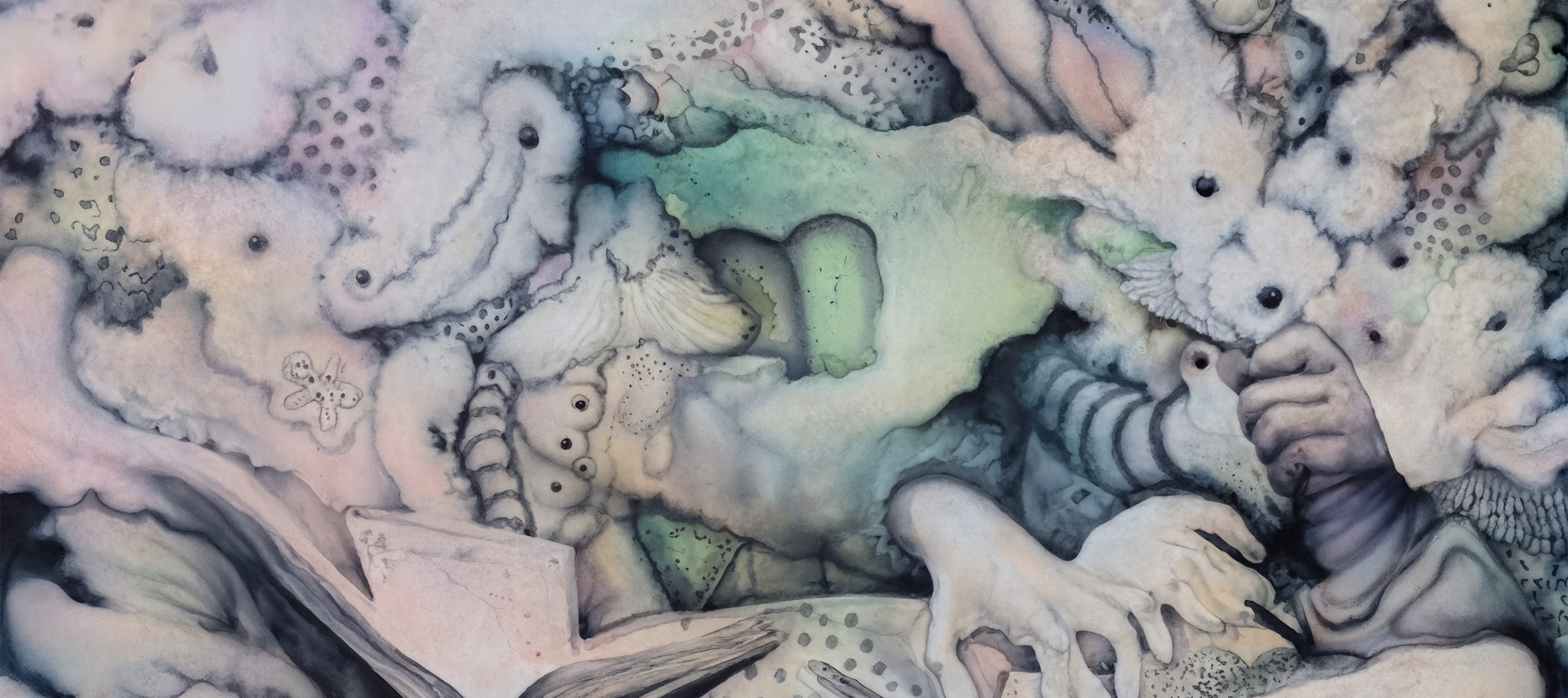
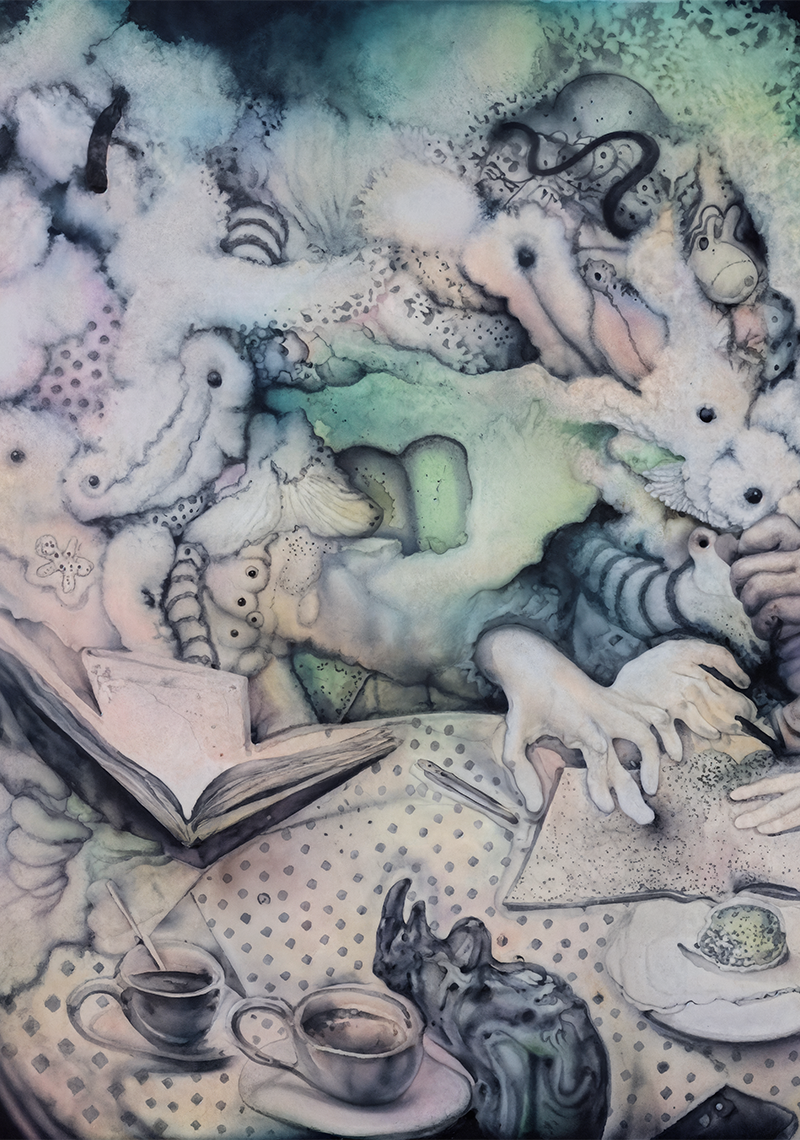
In the context of Romanian Creative Week 2026, under the dome of the Central University Library of Iași — an emblematic space of the archive, of institutionalized memory, and of systematized knowledge — Lucian Radu proposes, through Toy Joy, an investigation into the status of the affective object within a contemporary framework that shifts its attributes with ferocious speed. The exhibition functions as a critical device that reconfigures the toy from an object of innocence into a complex semiotic unit, a carrier of memory, ideology, and identity projection.
The artist’s multidisciplinary practice (graphics, painting, sculpture) operates through fragmentation and reassembly. Recognizable silhouettes, articulated limbs, oversized eyes, or stylized heads are extracted from the morphology of familiar toys and reorganized into hybrid anthropomorphic structures. This process refers to an aesthetics of the post-object: the toy, a product of consumer culture, is no longer used but analyzed, deconstructed, and symbolically reinvested, while maintaining its status as a reservoir of emotional attachment.
Radu artistically exploits this ambivalence between the mass-produced industrial object and the intimate depository of memory. Through reassembly, he suspends the utilitarian function and reveals the affective infrastructure of the object. The “joy” in the title is not merely a primary affect, but a cultural construct mediated by industry, image, and repetition.
The anthropomorphization of forms indicates a contemporary tendency to project humanity onto matter. In a paradigm close to post-humanism, Radu’s works suggest a world in which the boundary between subject and object becomes permeable. The recomposed toy is no longer a childhood accessory, but a hybrid body, a quasi-subject that gazes at, interpellates, and destabilizes the spectator. The eye — a recurring motif — becomes here a symbol of the reciprocity of perception: the gaze is no longer unilateral, but reflective.
Under the library dome, these entities acquire an almost archival dimension. If the library archives written memory, Toy Joy exposes affective, pre-verbal memory, sedimented in objects. The exhibition thus establishes a dialogue between two types of knowledge: one rational-discursive and the other material-emotional. The toy becomes a “mnemonic artifact,” a document of identity formation within a global visual culture.
The process of fragmentation used by the artist can also be read as a metaphor for contemporary subjectivity — discontinuous, composite, built from symbolic remnants of the past. Reassembly becomes an act of identity reconfiguration. The anthropomorphic world created by Lucian Radu is not a ludic utopia, but a space of tension: between innocence and mechanism, between affect and production, between personal memory and collective imaginary.
Within Romanian Creative Week, Toy Joy affirms creativity as a gesture of symbolic recycling. The artist operates with fragments of a global iconography to construct a personal, critical, and reflective visual language. The exhibition does not invite nostalgia, but analysis: what kind of humanity do we project onto objects? What kind of identity is formed through them? And how does joy transform into a cultural code?
Toy Joy thus configures itself as a meditation on material memory and the way in which childhood objects continue to structure and alter the adult imaginary. It is not a return to play, but a visual theory of play — understood as a mechanism for the construction of meaning and as an affective infrastructure in contemporary culture.
Cristina Simion, curator
Artist
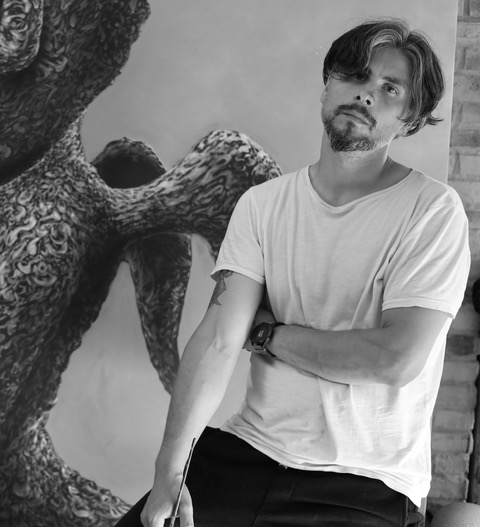
Lucian Radu
Multidisciplinary artist LUCIAN RADU (born 1986 in Iași) built a solid theoretical foundation through academic studies in the field of fine arts, with his initial focus on graphics (the specialization in which he graduated from both the “Octav Băncilă” Art High School and the “George Enescu” National University of Arts). His artistic practice combines painting, graphics, sculpture, and mixed media (airbrush).
His themes include pop culture symbols, memory, identity, and the childhood-adulthood ambivalence, socio-cultural critique, and reflections on the contemporary human condition. Radu’s works have been described as visual explorations of remembrance, the fragmentation of memory, and the way childhood and pop culture shape adult perception.
Important artistic projects and series:PIXELED MEMORY is a recent series of works that investigates memory and childhood nostalgia by reusing pop iconography (Little Pony, Hello Kitty, etc.) and through a symbolic aesthetic technique of “pixelation”—namely, the fragmentation of visual motifs to suggest how we remember the past. W.A.R. and W.A.R. II (We Are Right / We Are Right Too) are conceptual projects that dissect ideological mechanisms, ideas about power, and social conflicts—through deconstructed human figurines and symbols of lost innocence. ONE LOV3 is a recent series (2025–2026) of graphics, painting, and sculpture, which continues the exploration of the universe of childhood toys and their relationship with adult identity, from a mature formal and conceptual perspective.
Lucian Radu draws his inspiration from a broad arc of references—from academic tradition to modern symbolism and global pop culture—emphasizing the visual, psychology, and social readings of the image. His work is characterized by recurring symbols that explore innocence, memory, the power of symbols, and identity.
Curator
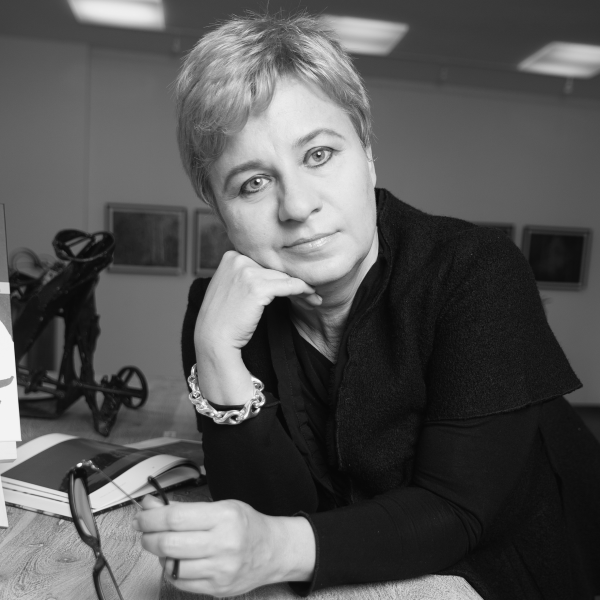
Cristina Simion
Curator and gallerist Cristina Simion has conceived and organized over a hundred solo and group exhibitions (especially of contemporary artists from Eastern Europe, mostly from Romania), in Nuremberg, Munich, Berlin, Paris, Lisbon, Sintra, Bucharest, Ljubljana, Brussels, Chișinău, Bled, Brașov, Sibiu, Cluj, Iași, Timișoara, Suceava, Bayreuth, Smarje, Schmerikon. With a special interest in new figurative art, she has written, edited and coordinated catalogues and art albums and published numerous articles. Since 2012, she has been based in Nuremberg, Germany, where she runs the Tiny Griffon Gallery. In 2019 and 2021, she was co-curator of the Brașov International Biennial of Visual Arts. With a PhD in the management of non-standardized industries and over two decades of experience prior to her curatorial career – in management, journalism and communication, Cristina Simion attended and graduated in 2018-2019 the International Curatorial courses organized by NODE Center for Curatorial Studies Berlin, and in 2022, the courses in Art Collections Management (also at NODE Center for Curatorial Studies Berlin) and Introduction to Art and Finance at Sotheby’s Institute of Art New York.
She has lectured, especially on topics related to artistic management, at Civitella d’Agliano, Horasis Global Meeting, Faculty of Arts and Design, West University of Timisoara, Transilvania University of Brașov. In 2022, she was, through Tiny Griffon Gallery, a partner of the international project « Artists at Risk », artistic residencies for Ukrainian artists.