
24.5.2025
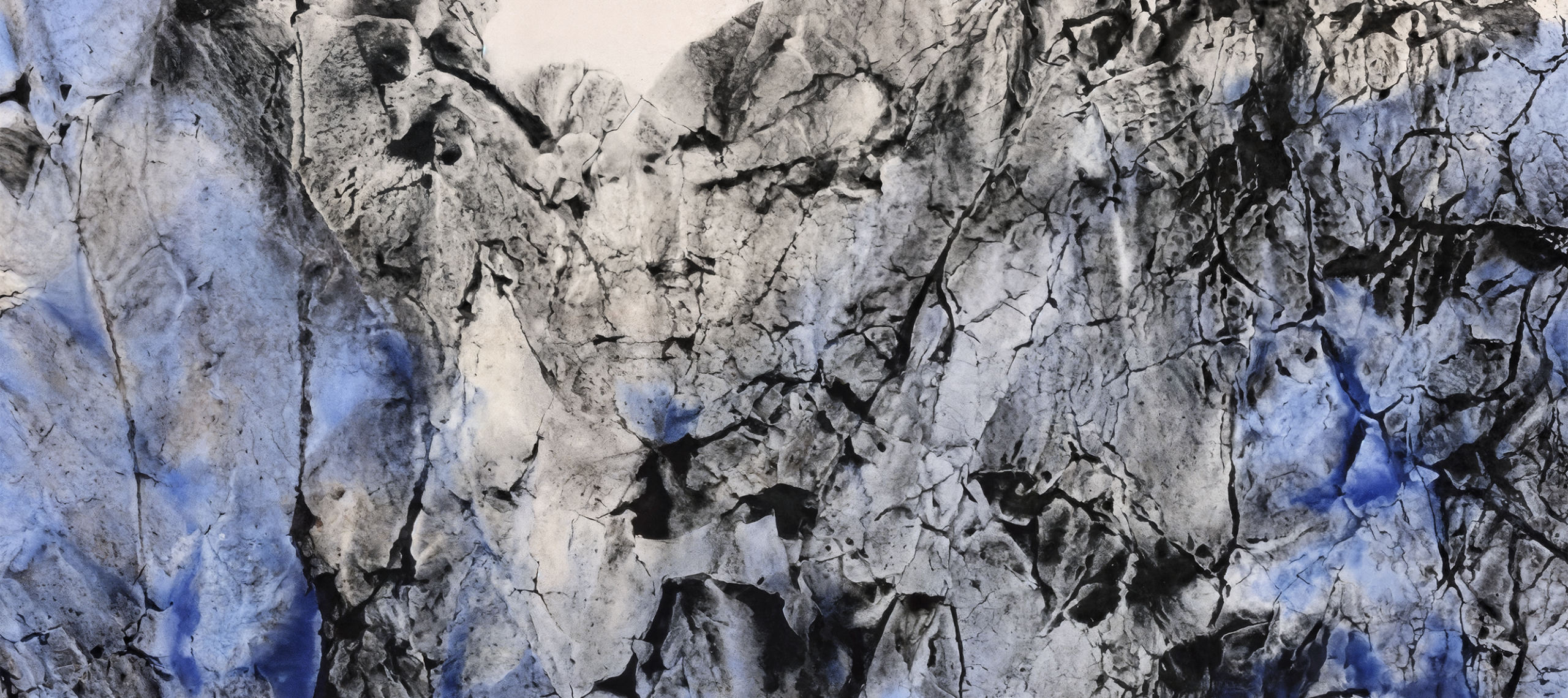
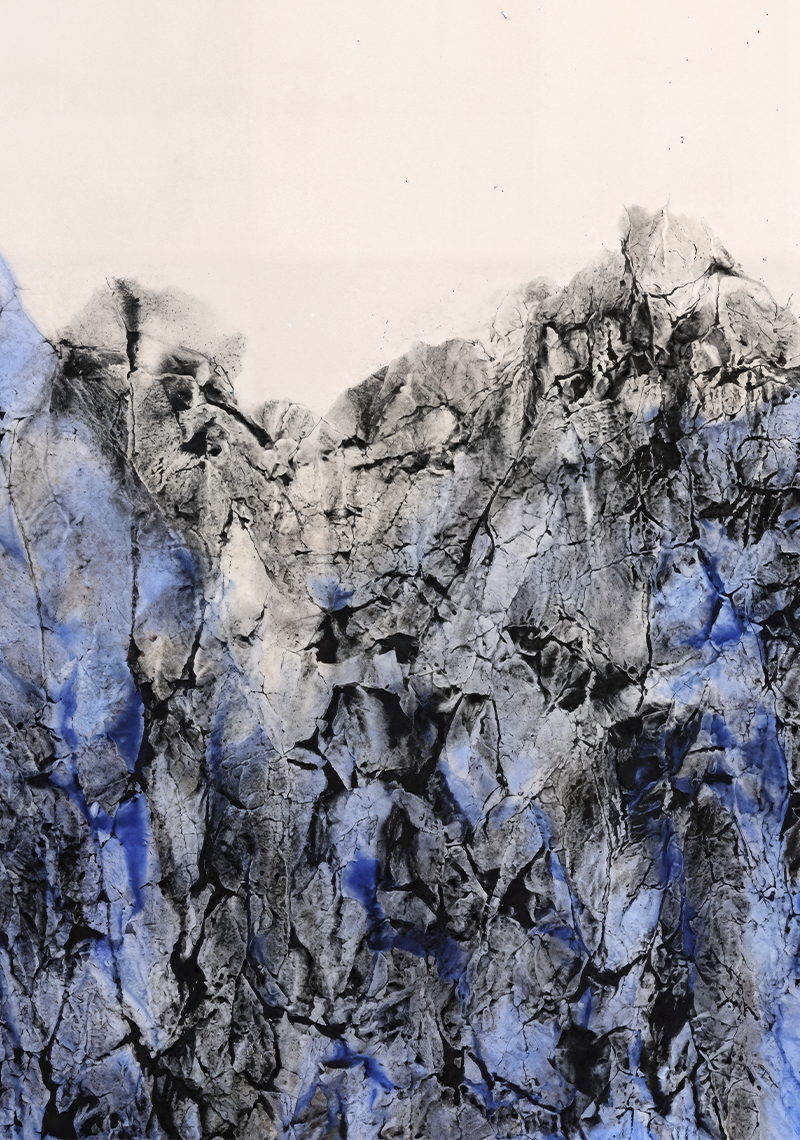
There are places that can be described and places that must be traversed internally. Bukovina belongs to the second category. In the BUKOVINA BLUE series, Roland Pangrati does not propose a simple return to the landscape, but a reconfiguration of it as a space of cultural memory, historical sedimentation and emotion filtered through time.
The choice of Bukovina is at the same time symbolic and pictorial. The region is not only famous for its spectacular relief, for the verticality of the Lady Stones or for the mineral texture of the rock, but also for its identity complexity: a territory of cultural interferences, of overlapping traditions, of spirituality visible in architecture and mural painting. Bukovina becomes, in this context, not just a place, but an archetype of coexistence and cultural fertility. The “Bukovina Blue” series builds a bridge between these layers. On the one hand, the works capture recognizable landscapes – especially the silhouette of the Lady Stones –, on the other hand, they descend in detail, in fragment, into the intimate structure of matter. This alternation between the panoramic and the microscopic destabilizes the classical convention of the landscape: we are no longer faced with a conventional space of contemplation, but a space of in-depth exploration.
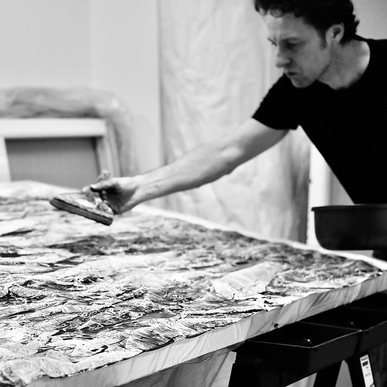
The unity of the series is not given only by the subject, but by the radical technical option. Pangrati resorts to the Japanese Nihonga technique, using natural mineral pigments applied to paper, in a process that privileges the slow sedimentation of color and a direct relationship with materiality. This choice creates a subtle dialogue between the Orient and the Eastern European space, between a pictorial tradition of refinement and a landscape charged with history and spirituality.
The azure blue becomes the conceptual core of the exhibition. More than a chromatic option, it functions as a historical bridge: the pigment used by the craftsmen who painted the frescoes of the monasteries in northern Moldova five or six centuries ago is reactivated here in a contemporary context. BUKOVINA BLUE thus becomes a material memory, a continuity of the artistic gesture over time. Azurite carries within itself the idea of sacredness, transcendence, but also resistance – it is an extremely persistent pigment.
In Pangrati’s works, blue does not only describe the sky or the shadow of the rock; it structures the space, spiritualizes it, abstracts it. The landscape is reduced to its essence, and the form is subjected to a purification that brings the image closer to a territory of meditation. Thus, the works transgress the genre of the landscape as a naturalistic representation and transforms it into a field of reflection on permanence and fragility.
The mineral detail becomes almost autonomous, detached from the context, transforming into a topography of memory. The rock is no longer just a geological element, but a silent witness of history and culture. Texture, fissure, stratification become metaphors of time.
The exhibition thus proposes a double movement: a return to the landscape and, simultaneously, an overcoming of it. Bukovina is not represented as a tourist image or as regional nostalgia, but as a space of convergence – between cultures, between techniques, between eras. Nihonga and azurite, paper and mountain, tradition and contemporaneity meet in an unusual, but all the more fascinating, balance.
BUKOVINA BLUE is, in essence, a meditation on continuity, on how a pigment can cross centuries, a technique can travel between continents, and a landscape can become an inner language. Roland Pangrati does not paint Bukovina; he translates it into a register of essence, in which color becomes memory, and memory becomes form.
Cristina Simion, curator
Artist
Roland Pangrati
After completing several university training courses in Tokyo, Japan, where he studied the traditional techniques of Japanese Nihonga painting, Roland Pangrati (born in Galați, in 1976, graduate of the National University of Arts in Bucharest) has outlined a personal style, located at the intersection of figurative and abstract. This artistic approach has given him recognition in the European space, as well as in Japan and South Korea. Starting with 2020, various cycles from the “Rocks” series have been exhibited by the Floraison Tokyo Gallery. Between 2021 and 2023, his works were selected at both the Busan International Biennial, South Korea, and the Brașov International Biennial of Visual Arts – Bienala Albastră.
In 2022, the exhibition “The Moon Glows the Same” was toured to five prestigious exhibition spaces in Romania. The series of works “Caminho da Agua e da Pedra” was presented, during 2024 and 2025, at the ICR Lisbon Gallery, the Sintra Art Museum, Portugal, the European Court of Auditors Gallery and the National Museum of the Romanian Peasant. In October 2025, part of the BUKOVINA BLUE series was exhibited in the Romanian Pavilion at the Osaka International Exhibition.
The central themes of Roland Pangrati’s work revolve around the relationship between nature and man, exploring the fragility and strength of the landscape, but also the subtle interconnections between organic forms and abstract structures. The artist often draws inspiration from mineral and geological elements, such as rocks, which he transforms into visual metaphors for permanence, balance and introspection.
Curator
Cristina Simion
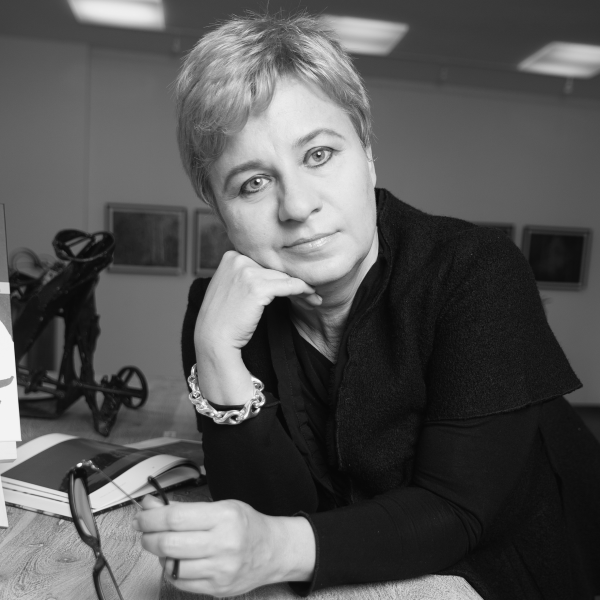
Curator and gallerist Cristina Simion has conceived and organized over a hundred solo and group exhibitions (especially of contemporary artists from Eastern Europe, mostly from Romania), in Nuremberg, Munich, Berlin, Paris, Lisbon, Sintra, Bucharest, Ljubljana, Brussels, Chișinău, Bled, Brașov, Sibiu, Cluj, Iași, Timișoara, Suceava, Bayreuth, Smarje, Schmerikon. With a special interest in new figurative art, she has written, edited and coordinated catalogues and art albums and published numerous articles. Since 2012, she has been based in Nuremberg, Germany, where she runs the Tiny Griffon Gallery. In 2019 and 2021, she was co-curator of the Brașov International Biennial of Visual Arts. With a PhD in the management of non-standardized industries and over two decades of experience prior to her curatorial career – in management, journalism and communication, Cristina Simion attended and graduated in 2018-2019 the International Curatorial courses organized by NODE Center for Curatorial Studies Berlin, and in 2022, the courses in Art Collections Management (also at NODE Center for Curatorial Studies Berlin) and Introduction to Art and Finance at Sotheby’s Institute of Art New York.
She has lectured, especially on topics related to artistic management, at Civitella d’Agliano, Horasis Global Meeting, Faculty of Arts and Design, West University of Timisoara, Transilvania University of Brașov. In 2022, she was, through Tiny Griffon Gallery, a partner of the international project « Artists at Risk », artistic residencies for Ukrainian artists.