
exhibition
17:00


In the modern and contemporary imaginary, bathing marks a radical mutation of the relationship with water. If deep water belongs to regression, dream and dissolution, the pool contains domesticated water, illuminated, brought to the surface and integrated into the rhythms of everyday pleasure. It is no longer the original or threatening element, but a space built for suspension, for slowing down. It becomes the scene of an ambiguous pleasure: solar, erotic, lazy, but tense. The water does not deepen, but reflects; it does not hide, but exposes. Desire is not consumed, but maintained in a state of floating, in a fragile balance between relaxation and latent conflict.
In contemporary art, the pool becomes a recurring motif precisely for this ambiguity. The body is not lost in the water, but is cut out, observed, suspended in an eternal afternoon. The water in the pool is not about depth, but about a continuous present, about a guiltless, almost impersonal pleasure. This form of pleasure can be read, from a Deleuzian perspective, as a gentle intensity: not a traumatic excess (jouissance), but a state that does not seek finality. In contrast to the Lacanian reading of desire as tension with the norm, the pool proposes a regime of desire that opposes nothing, does not transgress, does not dramatize. Desire floats. The water does not promise revelation, but continuity.
This direction functions as a solar counterpoint to the obscure, regressive, and dense water. The pool introduces another form of intensity: lazy, visible, almost frivolous, but deeply critical in a culture of exhaustion. It is a water of the surface, of suspended time, of pleasure that does not ask to be explained.
It is a water without guilt, without promise, without catharsis. That is why it becomes an extremely powerful motif in contemporary art: a place where the body exists without justification.
In ancient Greece, hydrophoria designated the collective ritual of bringing water, an essential community act, on the border between vital necessity and symbolic celebration. In this sense, the exhibition is placed between function and excess, between control and abandonment. The Turkish Bath amplifies this tension. Historically, a space of purification and community, it is also a place of the exposed, vulnerable body, freed from conventions. Here, hydrophoria intersects with the Dionysian dimension: water is no longer just a necessity, but pleasure, excess, dissolution of limits. Festivals dedicated to Dionysus celebrated the body, the fluidity of identity and the suspension of social order. In this Dionysian register, water is not opposed to fire, but complementary to it: both dissolve limits, both activate a state of crossing. If fire consumes through intensity, water does so through attraction: it slowly erodes, generating a pleasure of surrender.
Because some forms seem to exist precisely in the moment before surrender. The relationship between water and fire crosses the works not as an opposition, but as a fertile tension: the burning that fixes the matter and the fluid that threatens it, the form that closes and the desire that pushes it towards openness. Between them a state of productive obscurity is produced. Not a lack of meaning, but an excess of meaning, that space in which matter is no longer just matter, and pleasure can no longer be separated from risk.
Setup arh.
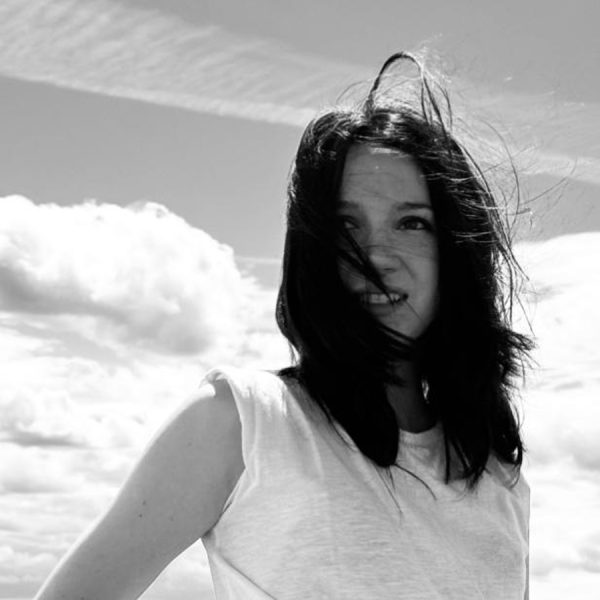
Carina Lăcătușu
Ana Carina Lăcătușu graduated from the Interior Architecture course at the Oxford School of Architecture (OBU), UK, in 2022. In 2023, she joined the Romanian Creative Week team. In 2024, during the 4th edition of the festival, she curated The Living Thread/ a live exhibition. The Living Thread invites people from all over the world to collaborate on sewing a single, unique Romanian blouse.
The project is now on a global journey, fulfilling its symbolic mission to complete this collective artwork.
Carina has studied the concept of “furnitecture” and its effective integration into different spaces, being strongly influenced by nature, visual arts and cultural identity in her creative process. She is currently focused on exploring new perspectives in exhibition design, scenography and furniture design.
Curator
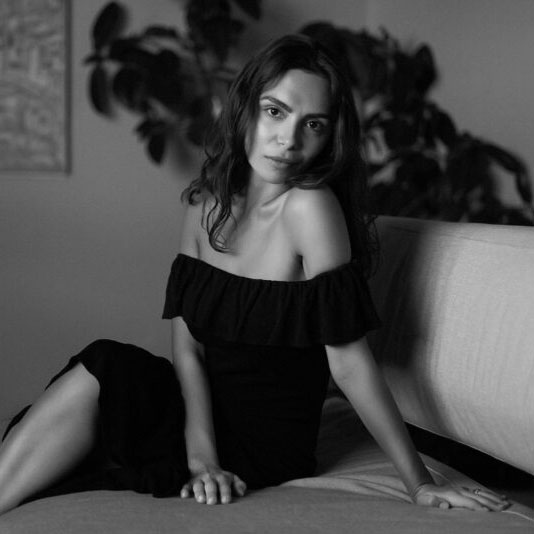
Caterina Pruteanu
Caterina Pruteanu has a background in cultural journalism (George Enescu University of Arts, Iași) and image studies (Center of Excellence in Image Studies, University of Bucharest).
She is part of the Romanian Creative Week team, the largest event dedicated to creative industries in the European Union, and co-founder of noinoi concept store, a place that privileges sustainable brands and design coherence, through an aesthetic that avoids excess.
Her interests include image theory, cultural anthropology and the relationship between aesthetics, sustainability and contemporary art practices.