
16:00


“The project works through a very simple gesture – the mirror – but manages to activate the space in a subtle and intelligent way. It does not propose an obvious scenography, but rather a framework in which the presence of man becomes the main content.
The idea of the mirror as a signal, which makes the presence in the space visible, is a rare one and well-anchored philosophically. Basically, it is not the object that is important, but the relationship it creates with the user. The fact that the modules can function both individually (as landmarks) and together (as a scene or place of introspection) gives them great flexibility for an urban context.
At the same time, the simplicity of the object is a great advantage because it does not impose a way of use, but leaves room for interpretation. People can pass by, stop, look at each other, interact without constraints. The act of being there becomes, indeed, performative, but in a natural way, without forced direction.
Another important aspect is the very “instagrammable” character of “The reflection in the mirror, the selfie, the play of frames, all are things that the public will instinctively adopt. This means visibility, distribution and, implicitly, the real activation of the space, even if the project does not directly generate a classic collective activity”
Jury
Amalia Enache (president)
Vlad Eftenie
Ștefan Ghenciulescu
Miruna Dunu
Catalin Alionte
Ștefan Lupu
Georgiana Dobre
What makes us human is our ability to adapt to any situation and find the best in it. In this spirit, the project started from the idea of creating an object that can find its place wherever it is placed and that, through its own presence, signals the unseen potential of the space just assumed. Like the strength and confidence we gain when there are more of us, in the same way the proposed object finds its power when it is accompanied by others like it. Together, the “milestones” can describe a scene or a place of state or a place of introspection or an opportunity to see ourselves in space with other people.
Being a city dweller is often overwhelming. We use countless spaces and rush past even more. We always think about what the city is missing without realizing that maybe everything is already in the city, but we haven’t realized it yet. The potential of many places to respond to the needs and desires of their inhabitants is always in sight, but hidden. Often, all it takes is a small signal.
The mirror of each object represents this signal, being an invitation to become aware of our presence in the space we are in. We are always present and continuously influence the places we pass through, even if we cannot always see ourselves there. The mirror makes each of us become the main actors in the center of attention. Thus, the project wants the simple presence of each person in the space to become a performative act.
The project proposes a modular approach, where each object is composed of 5 panels, 4 of which form a support that also serves as a place of standing and which supports the fifth panel, namely the “milestone”. Once the “milestone” is made, it can be easily assembled together with the support, and the entire object can then be placed anywhere in the city. The components are easy to transport due to their flatness and small size, and can be stacked, stored, and then assembled and disassembled. The 10 objects obtained can be permuted depending on the desired usage scenario or spread out individually.
Rareș David
Curator
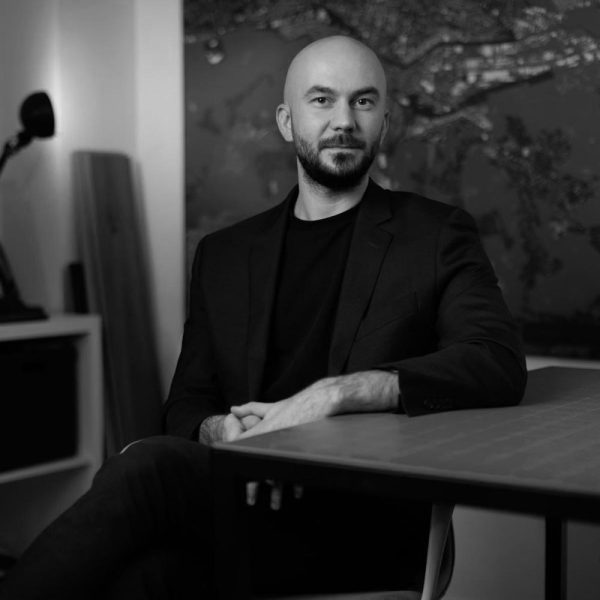
Andrei Bodnar
Andrei Bodnar is an architect and co-founder of ECHO, a studio that explores the urban future through projects that go beyond object design, focusing on research and revitalization strategies. The office’s practice emphasizes interventions in public space, essential elements for the social health of the city and catalysts for real change. This expertise is doubled by his experience as a consultant in strategic projects for the World Bank, where he contributes to the development of initiatives for cities in transition.
As Vice President of the Order of Architects of Romania – Iași Branch, he supports the dialogue about architecture in a platform accessible to the community, with a focus on the importance of the quality of the built space in everyday life. This year, at the fourth edition of the OAR events within the Romanian Creative Week, he promotes intervention in public space as a binder for the community and the city. The mix of professional vision and civic activism aims to create urban contexts that generate new energies and sustainable transformations in the city.